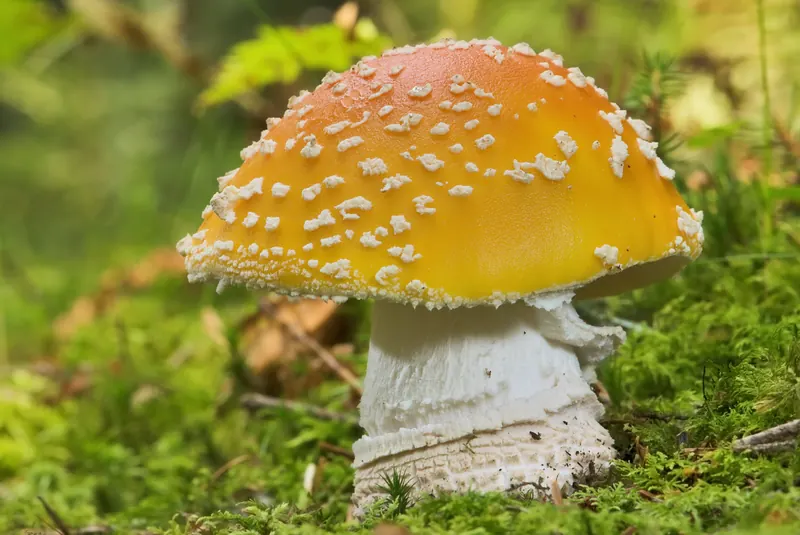

What is it?
Amanita muscaria, the fly agaric, is best known for its red cap with white spots (BfR). Its main active constituents are ibotenic acid and muscimol (Stoeva-Grigorova et al., 2025). Ibotenic acid converts to muscimol when the mushroom is dried or heated. Muscarine, despite the name, is present only in trace amounts (BfR).
Muscimol resembles GABA, the brain’s main inhibitory messenger, and acts on GABA-A receptors (BfR). Psilocin and related tryptamines act on the serotonin system instead (Correia et al., 2025).
What effects and risks are documented?
Germany’s Federal Institute for Risk Assessment describes alternating drowsiness and agitation, confusion, nausea, disorientation, hallucinations and impaired consciousness that can progress to coma. Effects usually begin about 30 minutes after eating and generally wear off within 24 hours, longer after large amounts. It specifically warns that children can mistake muscimol gummies for sweets (BfR). CDC lists hallucinations, agitation, gastrointestinal upset and seizures (Michienzi et al., 2024).
What has FDA said?
In December 2024, FDA determined that Amanita muscaria, its extracts, muscimol, ibotenic acid and muscarine don’t meet the safety standard for use in food. It treats them as unapproved food additives, and foods containing them are adulterated (FDA, 2024). In 2025 it told one company that its Amanita capsules and tincture were adulterated dietary supplements (FDA, 2025). Amanita muscaria itself isn’t a federally controlled substance (Michienzi et al., 2024).
What’s in Amanita-labelled gummies?
Often not Amanita:
- In a Portland study, one gummy listed muscimol and muscarine. Neither was detected in it or in any of the other 11 products (van Breemen et al., 2025).
- In another Portland study, the two products claiming Amanita muscaria contained no muscimol or ibotenic acid, but did contain psilocin and other tryptamines (Correia et al., 2025).
- In Virginia, gummies labelled with Amanita contained psilocybin, psilocin, DMT, mitragynine, ephedrine and caffeine. The lab couldn’t test for muscimol itself (Michienzi et al., 2024).
- Muscimol was found in some Diamond Shruumz products linked to the 2024 outbreak (Rumph et al., 2026).
So an Amanita label can mean a product with muscimol, a product with something else entirely, or both.
Sources
- German Federal Institute for Risk Assessment (BfR). Fly agaric poison: health risks of 'fruit gummies' containing muscimol – children are particularly at risk.
BfR reports poisonings from muscimol gummies reported by German poison centres, including impaired consciousness up to coma, confusion and agitation. Ibotenic acid converts to muscimol on drying and heating; effects usually begin about 30 minutes after eating and generally wear off within 24 hours, longer after large amounts. Children may mistake the products for sweets.
- Stoeva-Grigorova S, Yarabanova I, Radeva-Ilieva M, Ivanova D, Zlateva S, Marinov P. Acute Amanita muscaria Toxicity: A Literature Review and Two Case Reports in Elderly Spouses Following Home Preparation. Toxins (Basel). 2025;17(12).
Reviews Amanita muscaria toxicity: ibotenic acid and muscimol are the principal active constituents; effects are typically neuropsychiatric but variable. Two elderly patients who ate home-prepared mushrooms needed intensive supportive care and recovered.
- Michienzi A, Hamlin J, Farah R, Bazydlo L. Notes from the Field: Schedule I Substances Identified in Nootropic Gummies Containing Amanita muscaria or Other Mushrooms - Charlottesville, Virginia, 2023-2024. MMWR Morb Mortal Wkly Rep. 2024;73(28):628-630.
Blue Ridge Poison Center (Virginia) managed five people evaluated after eating gummies labelled as containing Amanita muscaria (Sept 2023–June 2024), including a 3-year-old who was hospitalised. Investigators bought six packages of five brands from gas stations and smoke shops; four of six contained unlabelled psilocybin or psilocin, with caffeine, ephedrine, mitragynine (kratom) and DMT among other unlabelled findings.
- U.S. Food and Drug Administration. Letter to Industry on the Use of Amanita muscaria or its Constituents in Food. December 18, 2024.
FDA determined that Amanita muscaria, its extracts, and muscimol, ibotenic acid and muscarine do not meet the GRAS standard and are unapproved food additives when used in conventional food; such food is adulterated and subject to enforcement. FDA reviewed more than 600 publications and serious adverse event reports.
- U.S. Food and Drug Administration. Warning Letter: Blue Forest Farms, LLC (CMS 711990). September 11, 2025.
FDA told a company that Amanita muscaria capsules and tincture sold as dietary supplements were adulterated because Amanita muscaria and its constituents are new dietary ingredients without the required notification, and that its Amanita chocolate was an adulterated food.
- van Breemen RB, Simchuk D, Fritzsche B, Huson D, Kuzdzal SA, Ferguson J. Active Constituents of Psilocybin Mushroom Edibles. JAMA Netw Open. 2025;8(9):e2531345.
Tested 12 'magic mushroom' edibles (11 gummies, 1 chocolate) bought at retail shops in Portland, Oregon. None contained psilocybin. Eight contained active ingredients not disclosed on the label: psilocin (3), synthetic tryptamines mipracetin and 4-HO-DET (2), caffeine (1), kava extract (1) and cannabis extract including Δ9-THC (1). Four had no active ingredient detected. Muscimol and muscarine, listed on one label, were not detected in any product.
- Correia MS, Gonzaga MJ, Temple C, Gerona RR. Quantitative analysis of recreational psychoactive mushroom gummies in Portland, Oregon. Clin Toxicol (Phila). 2025;63(4):261-266.
Eight gummy products from seven Portland, Oregon smoke and vape shops, analysed by LC-QTOF-MS. Neither ibotenic acid nor muscimol was found in the two products claiming Amanita muscaria; seven of eight contained psilocin and six contained 4-AcO-DMT. One product labelled psilocybin-free tested positive for psilocybin; one 'nootropic' product contained undisclosed Δ9-THC; kavalactones were also detected.
- Rumph JT, Winquist A, Troeschel AN, Pulver S, Schnall AH, Ebersole J, et al.. Severe Illness Associated with Eating Mushroom-Containing Chocolate Products - United States, January-October 2024. MMWR Morb Mortal Wkly Rep. 2026;75(13):179-184.
CDC/FDA investigation of poisonings linked to Diamond Shruumz microdosing chocolate and other mushroom-containing chocolate products, January–October 2024: 180 cases in 34 states, 73 hospitalised, 38 admitted to intensive care, 29 intubated, 2 deaths. Testing of some Diamond Shruumz products found muscimol, psilocin, kavalactones and other substances in some but not all products.